

A product can work perfectly in a controlled development environment and still fail the moment real customers touch it. People use unexpected devices, skip onboarding steps, misread instructions, and combine features in ways nobody planned for. Beta testing exposes those problems before a wider release.
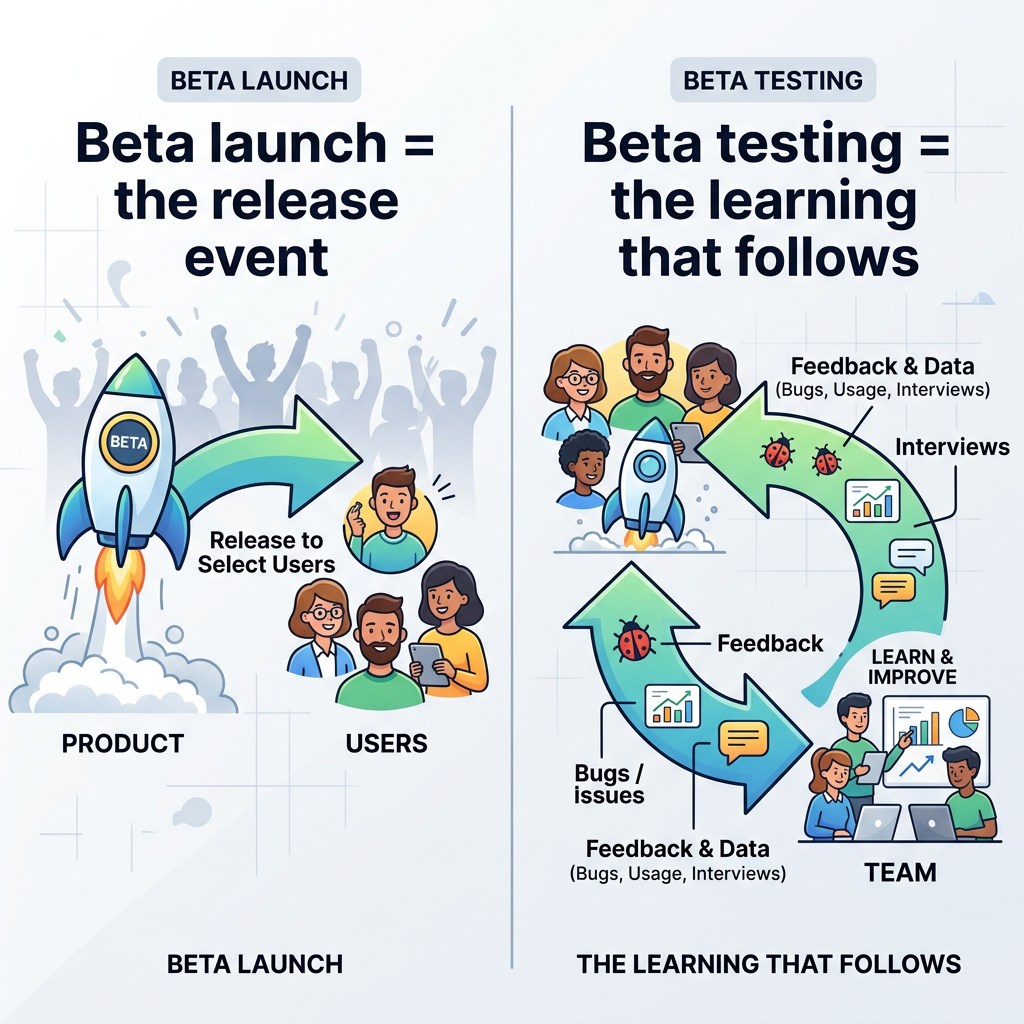
Beta testing and a beta launch are not the same thing
Beta testing is the learning process: giving a pre-release product to real users in realistic conditions, then watching what happens. A beta launch is the controlled release that makes it possible.
A startup might give its booking platform to twenty local service businesses. Handing over access is the beta launch. Watching whether those businesses configure availability, receive bookings, hit errors, and keep using the product is beta testing.
A beta launch is still a real launch. Support has to exist, data has to be protected, and serious failures still damage trust. What changes is that you control who gets in and what they expect.
Where a beta sits in the sequence
Prototype, then alpha testing, then the beta launch, then beta testing, then general release. Alpha testing is mostly internal and mostly about major bugs. Beta moves the product to real or representative users in a production-like environment.
A product should not enter beta because a deadline arrived. It enters beta when the core journey works reliably enough that testers can judge whether the product is useful, instead of repeatedly tripping over basic failures.
Closed beta or open beta
A closed beta is invitation-only: existing customers, a waiting list, early adopters, design partners. It gives you control over who participates and makes interviews and individual support practical. An open beta produces more volume and more variety of devices and expectations, at the cost of reputational and operational risk.
Most teams should start closed. Ten testers who actually use the product tell you more than a thousand who signed up and never came back.
Decide what the beta has to prove
"Tell us what you think" produces comments about colors. Define the assumptions first. Most betas need to answer five questions.
Does the core operation survive real data, real integrations, and unexpected usage? Can users act without constant assistance, given that a workflow can be technically correct and still be confusing? Are they getting value, or just completing steps? An account created is not success. A real completed booking might be.
The last two questions are about you rather than the product. If users consistently expect something different from what they get, the problem is the promise rather than the interface. And you need to know how much support each user takes, which questions repeat, and whether your analytics are capturing the events you will want later.
Running the beta
Start by writing down the decision the beta should inform. "We need to know whether service businesses can configure availability and receive their first booking without us setting up the account" gives you something to test. "We want users to test the platform" does not.
Then set entry criteria before anyone gets in: the essential journey works end to end, no known critical security or data-loss issues, payments and permissions tested, error monitoring live, key events tracked, known limitations documented. The product does not have to be complete. It has to be safe enough to produce evidence worth acting on.
Recruit testers who resemble the customers you intend to serve, rather than whoever is willing to use something for free. Friends and colleagues will find the obvious bugs, but they are unusually patient and reluctant to criticize, so they should never be your only source of evidence.
Tell participants what they are getting: what works, what does not, how their data is handled, how long the beta runs, how to report problems. "Beta" describes maturity. Careless software is still careless software with a label on it.
Onboard people toward the outcome rather than the feature list. Give testers a reason to reach the first meaningful result, then stop short of guiding every click, which hides exactly the usability problems you are looking for.

Collect both kinds of evidence. Behavioral data shows what users did: activation, task completion, errors, abandonment points, time to first useful outcome, retention, support volume. Interviews explain why. Analytics may show onboarding abandoned at step three, and an interview reveals that nobody understood why that information was needed.
Sort the findings before acting on them. Separate critical defects from usability obstacles, positioning mismatches, feature requests, and individual preferences, then weigh frequency, severity, and effect on the core outcome. One vocal tester's request is not automatically more important than a silent failure hitting half the cohort.
Last, define exit criteria. Without them, products stay labeled "beta" indefinitely while the team keeps shipping features and never decides whether the original risks were resolved. Reasonable conditions: no unresolved critical defects, core task completion above an agreed threshold, evidence of repeat usage, and a support load the team can sustain.
The mistakes that waste a beta
Launch too early and the only thing you learn is that the product is broken. Launch too late and you have spent months on features nobody asked for.
The subtler failures are about who you invite and what you listen to. Testers from outside the target market produce false confidence, and asking only for opinions ignores the gap between what people say and what they do. Inactive testers count as evidence too. Someone who never opened the product is telling you something about motivation, onboarding, or fit, and it is worth finding out which one.
A beta will not tell you the product is finished. It lowers the odds that a full launch goes badly, for the company and for the customers who arrive expecting something that works.
If you are planning a first release and want one team accountable for scope, instrumentation, and the launch itself, see how One Peak approaches MVP development, or read the founder MVP launch checklist.